
Getting and Spending Money in Sonora
Pre-Trip Preparation
Converting Dollars to Pesos
Withdrawing Pesos from a Mexican ATM
Making Purchases with American Dollars
Making Purchases with Mexican Pesos
Making Purchases with Credit and Debit Cards
Note: Since writing this story in July, the dollar has had an upsurge, to more than 13 pesos to the dollar. So Sonora is now even more affordable! Click here to see the current exchange rate.
So you’re planning a trip to Sonora, but aren’t sure whether your should buy pesos in the United States before leaving for your trip, whether you’ll be able to purchase with dollars in Mexico, or use your credit cards? Following are some tips to help you plan your trip effectively, so that you are aware of cash and credit options for your spending needs.
Pre-trip Preparation
When traveling in Mexico you will have three payment method choices – paying in U.S. dollars, paying in Mexican pesos, or paying with plastic (a transaction in Mexican pesos that is converted to dollars).
Before departing on your journey, consult with a site like XE.com (http://www.xe.com/ucc/), to get a general idea of the current international exchange rate between dollars and pesos. You can use this basic knowledge at different points to determine whether you’re being offered an acceptable rate of exchange when purchasing pesos.
Also, if you plan to take credit or debit cards to Mexico, contact the financial institutions associated with the cards to find out how to contact them from outside of the U.S. (preferably a toll-free international telephone number), and to ask how much they charge for ATM and credit/debit transactions. Keep the contact information in a safe place (apart from where you’ll keep the cards).
If you want to obtain currency and negotiable instruments before leaving for your trip, you can purchase traveler’s cheques in dollar denominations from your bank or travel agency, both of which may also be able to sell you pesos (albeit not at the best rate of exchange). Oftentimes you can also purchase pesos from U.S. banks near the border, from AAA, or from currency traders.
Converting Dollars to Pesos
It seems like just a couple of short years ago, as a visitor to Mexico you could get an exchange rate of 14 Mexican pesos for a dollar. Since then, the value of the greenback compared to the Mexican peso has fallen sharply, to where the international exchange rate stands between 11 and 12 pesos to the dollar. The Federal Reserve’s around-the-clock money printing press may help to ensure more favorable demand for exporters of American products, but it’s been no help to American tourists in Mexico.
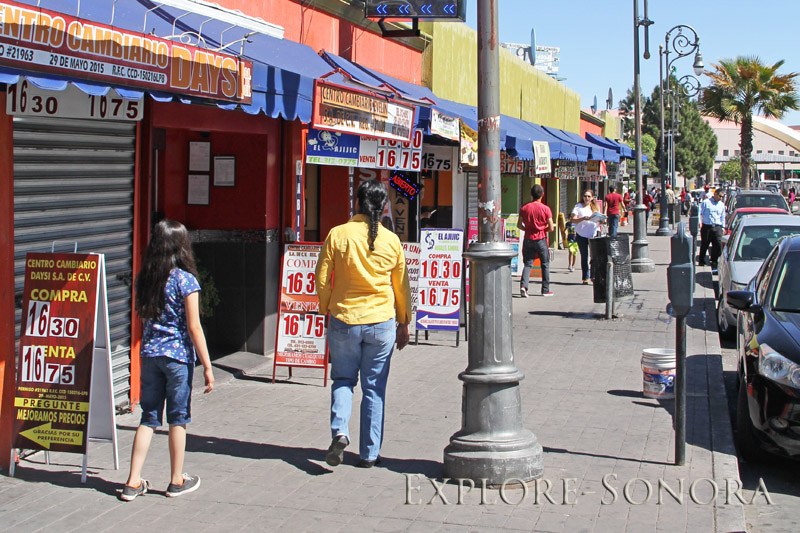
There are basically two options for converting dollars to pesos in Mexico – a bank or a casa de cambio (money exchange). Both types of currency exchangers will have the “buy” and “sell” rates for dollars and pesos posted prominently, and if they don’t, ask what the current rate is (and how many pesos you will get) before you give them your dollars.
The casas de cambio and Mexican banks will offer exchange rates below the current international exchange rate (that’s how they make their money). Mexican banks will exchange both cash and travelers cheques, oftentimes at a rate that is typically better than what the casas de cambio will charge. However, due to Mexican federal regulations implemented in 2010 to curb international money laundering, you may find that you have to fill out a bank form to make the transaction.
Withdrawing Pesos from a Mexican ATM
You’ll get the current international exchange rate for a withdrawal of foreign currency from a foreign ATM. So making a withdrawal from a Mexican ATM (known as a cajero automatico, or automated cashier) seems like it would be a savings over selling dollars to buy pesos. But unfortunately, but due to the fees involved, this is only true for withdrawals of larger amounts of money.
In addition to the cash you withdraw you’ll pay a fee to the machine at banks (from 29 pesos at BanaMex to 38 pesos at Banorte) and convenience store ATMs, which charge 60 pesos or more. And that’s in addition to what your financial institution will charge, which is typically $5.00 for a foreign ATM withdrawal.
To illustrate, in comparing withdrawals of $100 and $300 from a Mexican ATM on a day (like the day when I wrote this) when the exchange rate is 11.62 pesos / dollar:
Bank ATM
Dollars |
Pesos |
ATM Fee |
US Bank Fee |
Total Cost |
Effective Exchange Rate |
$100 |
1162.19 |
$2.50 |
$5.00 |
$107.50 |
10.81 |
$300 |
3486.57 |
$2.50 |
$5.00 |
$307.50 |
11.33 |
Convenience Store ATM
Dollars |
Pesos |
ATM Fee |
US Bank Fee |
Total Cost |
Effective Exchange Rate |
$100 |
1162.19 |
$5.16 |
$5.00 |
$110.16 |
10.55 |
$300 |
3486.57 |
$5.16 |
$5.00 |
$310.16 |
11.24 |
The banks in most Sonoran towns are near the downtown (centro), and most of them have an ATM. Convenience stores are popping up everywhere, and you’re sure to pass at least one as you drive through a city or town.
A word of caution about convenience store ATMs though, from my personal experience. I was once withdrawing money from a convenience store ATM in Sonora, and the currency wasn’t dispensed when it should have been. A helpful person who was waiting in line behind me lent me his pen, and I was able to insert it into the machine to extract the money.
We examined the machine and found that someone had put double-sided sticky tape inside, where the money comes out, so that when the money was dispensed it stuck to the tape. This was apparently by design, so the criminals to extract the money while the customer unwittingly went to the convenience store clerk for assistance.
Making Purchases
American Dollars
It used to be that dollars were the preferred currency for Mexican transactions, but I’ve heard stories from fellow travelers about some small Mexican businesses, from taxi drivers to taquerias, who won’t even accept dollars. This may be due to the weak dollar, issues with counterfeiting, or new regulations for depositing dollars in Mexican banks.
And for some more bad news, if you want to use dollars to buy something at a convenience or other retail store, or basically any other store in Mexico, you may get a much less favorable exchange rate than the current international rate, and likely worse than you’d get at a casa de cambio.
I recently made a purchase at an Oxxo convenience store on a day when the international exchange rate was 11.75 pesos to the dollar, and Oxxo’s exchange rate was 10 pesos to the dollar. As a consolation, at least I got free ice in the bag with my six-pack. And recently, another Oxxo store in Caborca wouldn’t even accept my dollars, nor would grocery stores Ley and Santa Fe..
Mexican Pesos
Travelers to Mexico should have small-denomination peso bills and coins available for making day-to-day purchases, and for incidentals like giving a tip to the bag clerk at the grocery store or the gas station attendant who washes your windshield. If you withdraw an amount over 500 pesos from an ATM machine, chances are you’ll get a 500-peso bill, which can be very difficult to spend in Mexico. If you don’t believe me, try buying a taco (or anything else that costs less than 450 pesos) at a roadside taqueria.
Even 200-peso bills can present a purchasing challenge. If you give a store clerk a 200-peso note and she passes it to a coworker who then leaves the store, don’t panic. The coworker is going to a nearby store to see if they can break the bill. Vendors typically cooperate in that manner, but it’s still better to have smaller denominations of currency if you want to make small purchases.
If you’re stuck with big bills from an ATM though, you can usually get change from the bigger bills (500 pesos, 200 pesos) with no hassles by making a small purchase from a grocery store or a convenience store and getting smaller denomination bills as change.
Credit and Debit Cards
I’ve noticed that recently there has recently been an increase in the numbers and types of stores in Sonora that accept credit and debit cards for making purchases electronically. This has its good and bad points.
It’s good, because it’s very convenient and much less expensive than paying with cash that you’ve withdrawn from an ATM. So when you’re driving down the road and spot an Oxxo store, you can stop in and buy a cup of coffee, or some sodas, sandwiches and snacks. And with a swipe of a card and signature you’re on your way.
Your financial institution will charge an international currency conversion fee for the transaction, typically about one percent of the transaction (as mentioned earlier, before leaving on your trip check with your financial institution to see what they charge) and the transaction will be converted at that day’s international conversion rate.
However, the expanded availability of credit can also be bad, due to potential theft or fraud. One thing I’ve noticed about using plastic in Sonora is that other than lodging transactions, the retail clerk never checks the identity of the card holder. Not in grocery stores, not in convenience stores, not in restaurants, not in any store where I have used plastic. So keep an eye on your card at all times, because if you lose it, until you report it as missing anyone who finds it can easily use it to make purchases.
Lodging transactions for credit cards are typically secure, although don’t allow the hotel or motel to keep your account “open” for other transactions. This can be convenient if you want to eat at the restaurant and charge the bill to your room, for example, but I’ve always gotten the distinct impression that it also continues to make your credit card information to users of the hotel’s computer network.
If you’re planning to stay at a smaller motel, be prepared to pay in pesos. Many of the hotels simply don’t use credit card processing due to the high merchant fees associated with credit card transactions in Mexico.
And as mentioned earlier, you may want to have a list of toll-free international contact numbers for all financial institutions you carry in your wallet. Keep the list in a safe place away from your wallet, so that you can contact the banks in case your cards are lost or stolen.
Also, be very careful if you’re using a debit card (it’s best to use a credit card), because they can be (and often are) “cloned” into a phony card that can be used to make purchases in Mexico and the U.S. Never use a bank debit card in a restaurant or any other place where the card will be out of your sight during processing. And if you see a retailer swiping your card in more than one card reader, report it to authorities immediately.
The key to having an enjoyable travel experience in Mexico is to reduce sources of stress as much as possible. Dealing with money and considering how to buy things can be two of the more stressful parts of traveling, so if you can prepare in advance for your purchasing needs it will not only relieve travel-related stress but also help you to enjoy the other parts of your journey and have fun! And isn’t that the whole point of vacation travel?